
To be honest, the side mirror folding mechanism is a component that normally receives very little attention — too small, too cheap, too much of a given.
But every year when cold-region testing runs, problems with this component start surfacing — folding squeaks, completely jammed at -20 to -30°C, and after tens of thousands of cycles the mirror housing begins to wobble. Open it up and you will find the grease inside the mini gear box either dried out or pushed to one side, with extensive wear marks on the gear tooth surfaces.
Today we will get to the bottom of this.
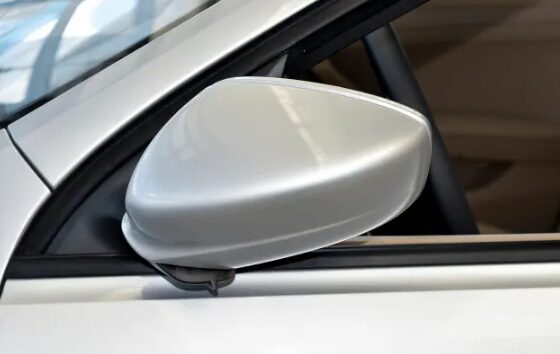
Characteristics of the Side Mirror Folding Mechanism
This mechanism is essentially a mini DC motor driving a single-stage or two-stage plastic gear reduction, using POM or PA66 gears meshing with a metal worm or plastic gear ring. The space is extremely limited — too much grease and it overflows, too little and it is insufficient. Speed is not high, but torque fluctuation is significant, especially the impact when folding completes.
Most importantly, it is installed outside the vehicle.
Winter temperatures of -20 to -30°C are routine. The demands on grease in these conditions are entirely different from interior applications.
Root Cause of Low-Temperature Jam
Many people assume that low-temperature jamming is a motor issue — insufficient torque to drive the mechanism.
Actually, it is not. Motor torque does decrease at low temperatures, but the primary cause is that the grease viscosity surges, and the motor’s limited torque simply cannot drive the mechanism. Replacing with a higher-power motor at this point is a dead end — cost goes up and failure rates may not decrease.
The real issue lies in the low-temperature fluidity of the grease. How much does ordinary grease viscosity increase at -30°C? Some increase by over 150%, and some even freeze into a semi-solid state. The motor cannot drive it, folding slows down, and eventually jams completely. When the overload current rises, the DTC immediately registers a fault.
Where Does the Noise Come From?
When the mirror makes a squeaking or creaking sound during folding, most people’s first reaction is that gear precision is insufficient.
Frankly, gear precision is one factor, but more often the problem is lubrication. Too much grease and viscosity too high cause the gear to churn the grease to one end of the gear box during operation, leaving the meshing zone starved of lubricant. Direct dry grinding of the tooth surfaces produces the noise.
Additionally, ordinary greases lack sufficient anti-wear performance. With repeated gear start-stop cycles and repeated impacts, tooth surface wear generates debris that mixes into the grease and becomes an abrasive paste, accelerating wear until the gear clearance increases and the mirror housing begins to wobble. This is a typical lubrication failure chain.
Bench Test Data
We built a bench test specifically for the side mirror folding mechanism, simulating three operating conditions: -30°C low temperature, room-temperature durability, and high-temperature durability.
VNOVO’s mini gear box lubricating grease uses PAO synthetic base oil with a complex lithium thickener and PTFE solid lubricant; the consistency is tuned to a relatively light grade, approximately NLGI 1.
Test data:
At -30°C, the starting torque increases by less than 30% compared to room temperature; ordinary grease increases by over 150%, with significantly higher motor current. After 50,000 folding cycles at room temperature, gear wear depth is 3–6 μm, versus 10–15 μm for ordinary grease. The ordinary grease gear boxes show明显more debris and the grease turns black. After storage at 90°C, no flow or drippage occurs; evaporation loss at 100°C/24h is less than 2%. Compatible with POM, PA66, PC, ABS, and common sealing rubbers — no swelling.
Coating quantity is critical — 0.1 to 0.2 g per gear box assembly is sufficient, applied to the gear meshing faces and bearing seats. Do not overfill; overfilling increases churning resistance.
Selection Recommendations
When selecting grease for the side mirror folding mechanism, several hard requirements apply:
Base oil: PAO or ester synthetic, pour point below -50°C, evaporation loss less than 2%. Thickener: complex lithium or polyurea, dropping point above 200°C. Solid lubricant: PTFE or molybdenum disulfide. Low-temperature torque increase controlled within 50% at -30°C. Consistency NLGI Grade 0.5 to 1.5 — do not use too thick a grade. Coating quantity must be precisely controlled, preferably with an automatic dispensing machine.
Has your side mirror folding mechanism experienced low-temperature jamming or abnormal noise during durability testing? Is the gear box sealed or semi-sealed? How is the motor stall current set? Have you conducted low-temperature start current monitoring?