
By VNOVO Technical Support Team
With more than 10,000 units delivered in 2025 and a 2026 target of 30,000 to 50,000 units, Robotis has demonstrated with solid numbers that large-scale mass production of dexterous hands is no longer a question of “whether it can be done,” but rather “how fast it can go.” However, behind the lively, there is actually an unspoken industry consensus: dexterous hands face an “impossible triangle” of cost, performance, and reliability, and no product currently on the market has fully broken through all three corners.
Among the three corners, reliability is the most difficult to quantify and the most easily overlooked.
The underestimated lubrication failure
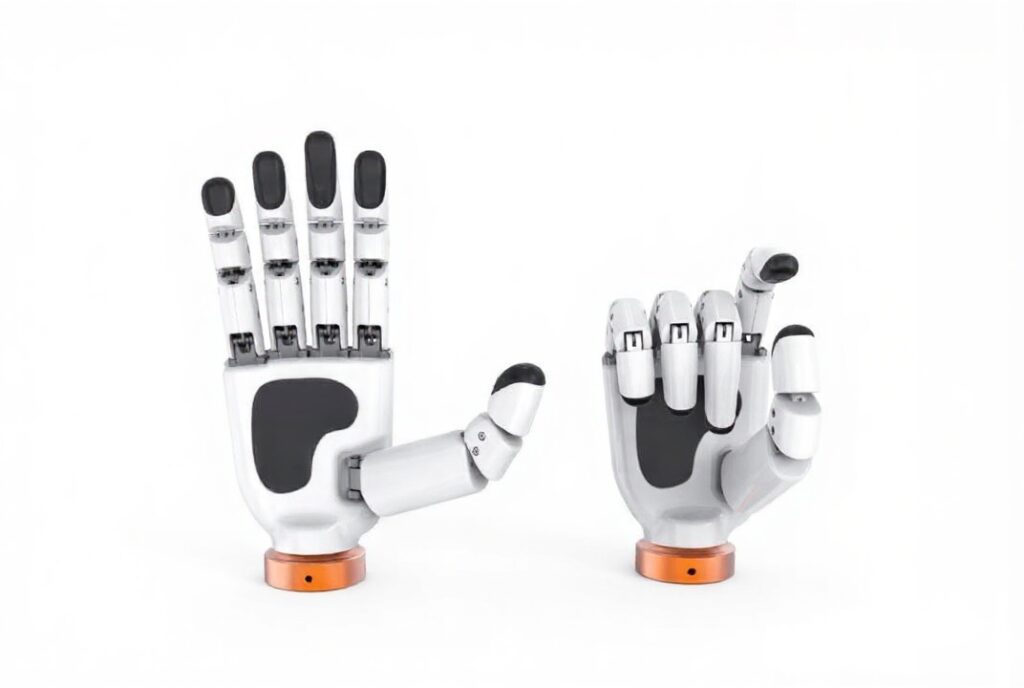
A single dexterous hand typically integrates more than a dozen joints, each containing a micro planetary reducer with gear modules often as small as 0.3 or even less. These small-module gears in dexterous hands do not endure high-speed heavy loads — instead, they face high-frequency micro-motion: fine finger operations generate vast numbers of small-amplitude directional reversal cycles, with gears repeatedly starting, stopping, and reversing under light loads.
The problem lies precisely here.
Traditional lubrication design targets steady-state operating conditions with constant gear speed and defined loads. However, the micro-motion conditions in dexterous hand joints are entirely different: gears almost constantly operate in the boundary lubrication zone, with the probability of two tooth surfaces making direct contact far higher than in continuously operating reducers. Micropitting near the tooth root and tooth surface spalling often start from here.
More troublesome is the direct destruction of the grease structure by high-frequency micro-motion. High-frequency micro-motion causes base oil to be repeatedly squeezed out of the oil film, grease separation rate increases, and the oil film becomes too thin to isolate direct metal contact. Meanwhile, solid lubricants (such as PTFE, MoS₂) may locally agglomerate after repeated disturbance in the dispersed system, losing their reinforcing effect on the oil film. After thousands of hours of operation, cone penetration decreases, the grease body hardens, and fluidity deteriorates — further aggravating boundary lubrication burdens. Under some operating conditions, base oil evaporation loss is also significant: mineral oil evaporation rates increase notably above 60°C, and the grease gradually becomes “hollowed out,” ultimately resulting in abnormal noise and accuracy degradation.
A small investment, a large lever
What is interesting is that lubricating grease typically accounts for less than 1% of the total machine BOM. But its failure cost can cut the entire joint’s service life significantly. If a dexterous hand with a design life target of 10,000 hours uses an improper lubrication solution, micropitting may begin after just a few thousand hours — ultimately discovered during routine fatigue testing. At this point, neither the reducer nor the motor has failed, making responsibility attribution difficult to clarify.
Conversely: on a system that has already fully optimized its motor, reducer structure, and control algorithms, switching to a more suitable lubricating grease is one of the few methods that can achieve the greatest reliability improvement with minimal modification. Used well, it can delay micropitting onset from tens of thousands of cycles to hundreds of thousands of cycles — clearly making up for the shortfall in joint service life.
VNOVO X500: The solution approach
Taking the VNOVO X500 dexterous hand joint dedicated grease as an example, its formulation approach is worth examining in detail: the fluoro-oil + PTFE system controls grease separation rate below 10%, with minimal base oil exudation and stable oil film replenishment. Extreme-pressure load-bearing capacity reaches 800 kg, ensuring sufficient load-bearing capability even in the boundary lubrication zone. The operating temperature range of -50 to 220°C covers the full operating condition window from low-temperature standby to high-frequency motion of finger tip joints. Fluoro-oil itself has a high viscosity index, meaning minimal oil film thickness variation across wide temperature ranges. Combined with PTFE solid lubricant dispersion reinforcement, it well balances the conflicting demands of low grease separation rate and high extreme-pressure performance. This product is currently used for joint lubrication in leading dexterous hand mass production projects at multiple companies.
Of course, there is no silver bullet for lubrication solutions. Selection still requires comprehensive evaluation combined with specific parameters such as speed, reversal frequency, and assembly space. But one thing is certain: in the competition for dexterous hand reliability, lubricating grease selection is an underestimated high-lever link — it deserves to be taken seriously.
Have you encountered situations in dexterous hand mass production testing where transmission component accuracy met specifications but overall hand lifespan fell short? How large a weight did the lubrication solution contribute? Feel free to share your experience in the comments.