

By VNOVO Technical Support Team
Food processing lines, pharmaceutical equipment, and medical devices share a requirement: lubricants that will not harm the product or patient if incidental contact occurs. From conveyor bearings in dairy plants to gearboxes in packaging machinery, from motor bearings in centrifuges to actuators in diagnostic instruments – every lubricated point near the product zone must use food-grade grease. Yet compliance alone does not guarantee performance. The grease must also handle washdown, temperature extremes, and long service intervals – all while meeting certifications that go beyond basic H1.
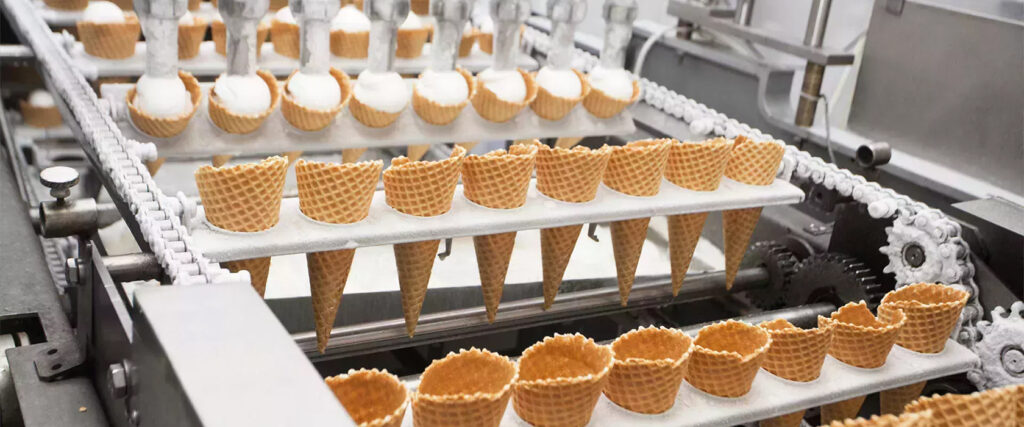
What Makes Food and Medical Equipment Applications Demanding for Food-Grade Grease?
Food and medical equipment present unique challenges:
– Mandatory regulatory compliance. Lubricants with potential incidental food contact must be NSF H1 registered (FDA 21 CFR 178.3570). Pharmaceutical and medical applications may also require ISO 21469, Kosher, Halal, or biocompatibility testing (ISO 10993).
– Aggressive washdown environments. Food equipment is cleaned with hot water, steam, caustic solutions, and sanitizers. Grease must resist washout without losing lubrication capability.
– Wide operating temperature range. Equipment spans freezer operations (-30 °C) to oven and sterilization environments (150+ °C). The grease must flow at low temperatures and resist oxidation at high temperatures.
– Heavy and shock loads. Mixer bearings, conveyor rollers, and packaging linkages experience significant loads. Food-grade greases must provide adequate anti-wear protection despite limited additive options.
– Extended relubrication intervals. Many machines run continuously with limited maintenance windows. Grease must perform reliably over long intervals without hardening or separating.
– Material compatibility. Equipment combines stainless steel, food-grade plastics, and elastomers. The grease must be compatible with all.
– Contamination risk from over-lubrication. Excessive grease can force lubricant into the product zone. Only the minimum quantity should be used.
Why Do Food and Medical Equipment Problems Persist Even When Food-Grade Grease Is Applied?
Six failure modes continue to cause issues:
1. Grease washout during cleaning. H1 greases with poor water resistance are displaced by washdown, leaving bearings under-lubricated.
2. Insufficient load-carrying capacity. FDA ingredient restrictions limit additive packages, reducing protection under heavy loads compared to non-food-grade alternatives.
3. Grease incompatibility during changeover. Switching from conventional to food-grade grease can cause thickener incompatibility, leading to softening, hardening, or phase separation.
4. Loss of consistency over time. Extended operation at elevated temperatures or repeated thermal cycles causes some H1 greases to oxidize or separate.
5. Using H2 grease at H1-required locations. H2 lubricants used where incidental contact is possible create a compliance gap exposed by audits.
6. Inadequate biocompatibility for medical. H1 covers food contact but not patient safety. Medical devices with patient exposure potential require ISO 10993 testing (cytotoxicity, skin irritation, systemic toxicity).
What Properties Determine Whether a Food-Grade Grease Will Perform in Food and Medical Equipment?
Key properties:
– NSF H1 registration. Baseline for incidental food contact. Verify the specific product registration.
– ISO 21469 certification. Adds manufacturing hygiene, product testing, and annual facility audits. Important for pharmaceutical and high-risk food applications.
– Water resistance and washout performance. Critical for washdown. Polyurea-thickened greases (e.g., Klüberfood NH1 72-132) and aluminum-complex greases (e.g., Mobilgrease FM series) offer strong water resistance with H1 compliance.
– Temperature range. Synthetic base oils (PAO) extend usable range versus mineral-based H1 greases.
– Load-carrying and anti-wear performance. Some H1 greases achieve good wear protection through approved solid lubricants or advanced thickener technology.
– Thickener shear stability. Polyurea thickeners show excellent shear stability in continuous operation, extending relubrication intervals.
– Additional certifications. Kosher, Halal, and MOAH-free formulations may be required.
– Biocompatibility for medical. ISO 10993-5 (cytotoxicity), ISO 10993-10 (skin irritation), ISO 10993-11 (systemic toxicity) for medical device applications with patient contact potential.
How to Select the Right Food-Grade Grease for Food and Medical Equipment
Step 1 – Identify the equipment type and requirements:
| Equipment Type | Typical Conditions | Key Requirement |
| Conveyor bearings (food line) | Washdown, moderate speed | H1, water resistance, rust protection |
| Motor bearings (centrifuge/fan) | High speed, elevated temperature | H1, shear stability, oxidation resistance |
| Gearbox (packaging machine) | Variable load, mixed materials | H1, AW/EP, material compatibility |
| Actuator (diagnostic device) | Low speed, patient proximity | H1 + ISO 10993, biocompatibility |
| Sterilization equipment | High temperature, steam | H1, high-temp stability, steam resistance |
Step 2 – Match thickener and base oil: Washdown → aluminum complex or polyurea + PAO. Motor bearings → polyurea + synthetic. Medical → PAO or PFPE with biocompatibility verification.
Step 3 – Verify certifications: H1 baseline. ISO 21469, Kosher, Halal as required. ISO 10993 for medical. Confirm thickener compatibility during changeover.
Quick Reference: Selection Guide
| Equipment / Condition | Key Properties | Direction |
| Conveyor (washdown) | H1, water resistance, rust protection | Al-complex or polyurea + PAO; NLGI 2 |
| Motor bearings (high-temp) | H1, shear stability, oxidation resistance | Polyurea synthetic (e.g., NH1 72-132 type) |
| Gearbox (variable load) | H1, AW/EP, material compatibility | PAO-based H1 with approved AW |
| Medical actuator (patient zone) | H1 + ISO 10993, biocompatible | PAO or PFPE; ISO 10993 tested |
| Sterilization equipment | H1, high-temp, steam resistant | High-temp synthetic H1 |
| Multi-certification needs | H1 + ISO 21469 + Kosher + Halal | Products carrying all certifications |
How VNOVO Provides Technical Support
VNOVO does not supply off-the-shelf “food and medical food-grade grease” with universal claims:
Application-Oriented Selection Guidance – VNOVO reviews your equipment type, operating conditions, product zone proximity, and certification requirements, recommending thickener type, base oil chemistry, NLGI grade, and certifications.
Material Compatibility Verification – VNOVO helps assess candidates against contact materials: stainless steel, food-grade plastics (POM, PBT, PEEK), seal elastomers (NBR, EPDM, FKM) – with emphasis on mixed-material compatibility.
Scenario-Based Communication Support – VNOVO provides rationales explaining *why* a direction is suggested, what trade-offs exist (polyurea = excellent shear stability and high-temp performance vs. aluminum complex = strong washdown resistance; PAO = broad temperature range vs. mineral = lower cost but narrower performance; H1 alone vs. H1 + ISO 21469 + ISO 10993 for medical), and what validation steps to prioritize.
Conclusion
When to use specialized food-grade grease in food and medical equipment
When equipment operates near the product zone requiring NSF H1, faces washdown conditions, runs at temperature extremes or under heavy loads requiring synthetic formulations, or must meet additional certifications (ISO 21469, Kosher, Halal, ISO 10993) for pharmaceutical or medical applications.
When a general-purpose approach may suffice
When the component is fully isolated from the product zone (H2 acceptable), operates at moderate conditions with regular relubrication, and no additional certifications beyond basic H1 are required.
What VNOVO can support
1. Selection guidance – translating equipment type, conditions, and certification requirements into thickener type, base oil chemistry, and NLGI grade
2. Material matching – assessing compatibility between food-grade candidates and all contact materials
3. Scenario communication – providing the technical rationale and decision framework to specify, validate, and apply the right food-grade grease for your food and medical equipment
This article is provided for informational purposes based on publicly available industry references and lubrication engineering principles. Specific product selection should always be verified against equipment manufacturer guidelines, OEM recommendations, lubricant supplier technical data, NSF registration, ISO 21469 certification, ISO 10993 biocompatibility data, and material compatibility testing.