
Calcium Soap Grease
Generally, calcium soap grease is a product obtained by adding mineral oil, fatty acids, calcium hydroxide, and water, followed by saponification upon heating to adjust the moisture content. Greases using tallow-based fatty acids require some water as a structural stabilizer, but temperatures above 80°C will cause water separation, structural damage, and separation of the soap and base oil. Therefore, this type of grease, due to its lack of heat resistance, is suitable for lubricating general bearings at temperatures below approximately 70°C and with relatively low speeds and low loads. Conversely, due to its excellent water resistance, it is suitable for lubrication conditions involving water.
Meanwhile, castor oil-based greases, due to their water-free nature and stable structure, can be used up to approximately 100°C.
Compound Aluminum Soap Grease (Compound Aluminum Grease)
Compound soap greases are formed by reacting aromatic carboxylic acids and stearic acid in aluminum hydroxide, possessing an extremely fine fibrous structure. With a dropping point above 200°C, it is a grease with excellent heat resistance, water resistance, and shear stability. Lithium Soap Grease
Lithium soap grease is a universal grease used in general industry, the automotive industry, various bearings, and even household appliances. It is the most widely used grease. Its components include mineral oil or synthetic oil and lithium stearate, or lithium salts of hardened fatty acids from castor oil. It has a wide operating temperature range and good water resistance and shear stability.
Compound Lithium Soap Grease (Compound Lithium Grease)
Lithium hydroxide is added to a mixture of fatty acids and dibasic acids to react and form a fibrous structure. It has a dropping point above 250℃ and excellent heat resistance, water resistance, and rust prevention. Compared to ordinary lithium-based greases, it exhibits better high-temperature and long-life performance.
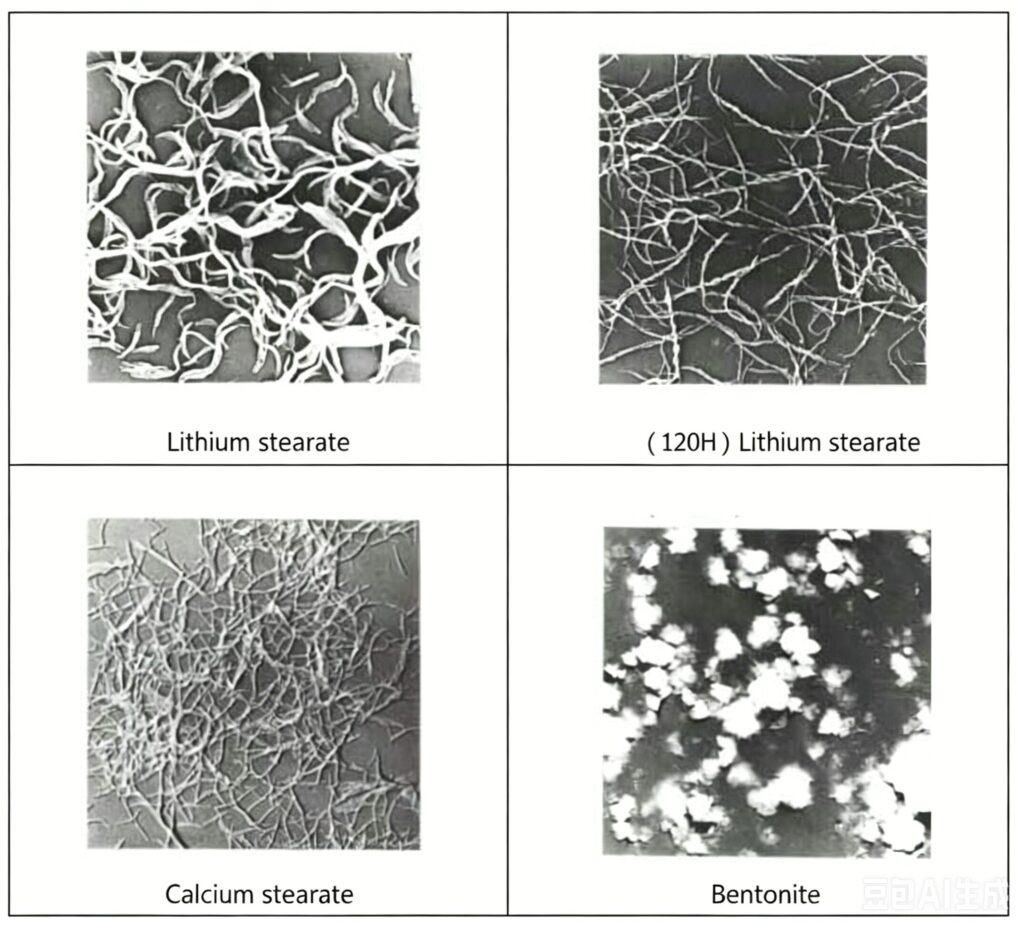
The fibrous structure of the grease thickener as seen under an electron microscope (magnification: ×10⁴).
.jpg)