

Have you ever noticed something?
When you first get a new car, pulling the door handle—that feeling: smooth, crisp, a muted thunk. The passenger next to you may not even notice, but you think to yourself: yep, this car is worth it.
Then one day, about a year later, you go to the 4S store for maintenance and casually ask: hey, this door handle is making a noise when I pull it. The mechanic takes one look, grabs a can of lubricant and sprays it—fixed.
A week later, it’s even worse.
I have seen this exact scenario at 4S stores for more than one brand. It is not a brand-specific issue—it is a systemic problem that is seriously underestimated. Today I am going to take this apart completely.
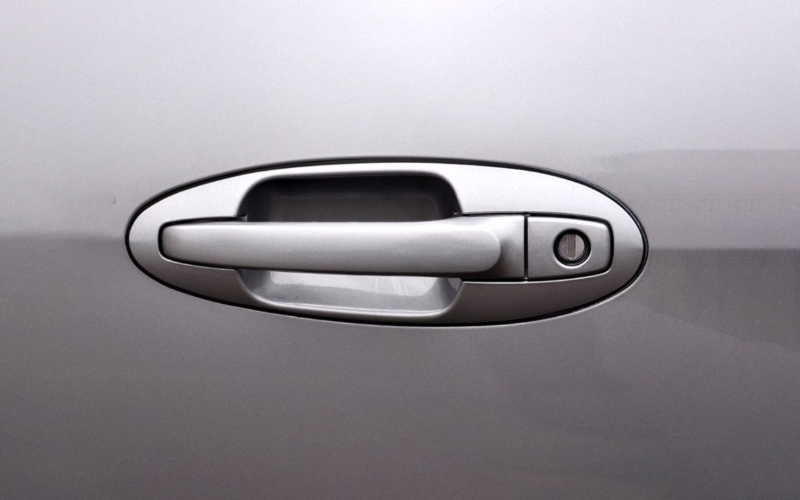
What Is Inside a Door Handle?
A normal automotive door handle has a rather sophisticated internal structure:
A metal rotating shaft with a plastic bushing (POM or PPS are the most common materials)
A return spring that stores energy during closing and releases it during pulling
Sliders and rails, using POM/ABS/PA66 engineering plastics
And the outer shell, ABS or other plastic
When the door closes, these components endure considerable impact. Temperature extremes as well—fifty to sixty degrees Celsius in summer, minus十几度 in winter, cycling through twenty-four solar terms—this all happens silently inside the handle.
So the lubrication conditions for door handles are, in reality, quite demanding.
Five Failure Mechanisms, One by One
First, shaft dry friction — this is the most common source of the “squeak.”
At the door handle shaft, under normal conditions grease should fill the space between the metal and plastic, forming a boundary lubrication film. But ordinary grease has insufficient adhesion—the impact of door closing combined with vibration gradually squeezes the grease out. Over time, the metal shaft and plastic bushing make direct contact, and when you pull, microscopic metal asperities scrape the plastic, producing the squeak.
Summer high temperatures accelerate this process—grease softens and is lost more easily. In winter the problem does not disappear; it manifests differently: the actuation torque increases, and the handle feels heavy.
Second, return spring stick-slip — this one most people do not know about.
The door handle spring’s coils should slide smoothly against each other. The problem: if the grease’s static friction coefficient is much higher than its dynamic friction coefficient, the spring must first overcome a “static friction peak” when starting to move, and then the sliding resistance suddenly drops.
The result is a “stick, then jump.” In door handle terms, this means the return is not crisp, there is hysteresis at the end, and sometimes metallic impact sounds.
This is what the NVH field calls stick-slip. The name sounds academic, but once you have heard it, you never forget.
Third, plastic-plastic interface wear — the hidden source of the “creak.”
Sliders and rails are both made of POM, ABS, PA66 engineering plastics. Compared to metal, plastic-plastic friction coefficients are inherently higher, and the wear debris produced is also harder. This debris embeds into the plastic surface, creating abrasive wear—a vicious cycle.
To make matters worse, mineral oil or certain additives in ordinary grease pose potential swelling risk to POM/ABS/PA66. As usage continues, fine cracks begin to appear on the plastic surface, and the noise actually gets worse.
Fourth, contamination and corrosion.
Door handles are not a sealed structure. Dust, rainwater, car wash liquid, and perspiration all get in. Low-quality grease absorbs dust and turns into sludge, blocking return channels; some contain high moisture content that corrodes plating layers, producing white powder that further increases friction.
This is not an occasional problem. In an open environment, it is inevitable.
Fifth, low-temperature thickening — the culprit behind handles that will not move in winter.
Ordinary grease uses mineral oil with a low viscosity index (VI). At minus twenty degrees, the base oil thickens and the entire grease becomes a sticky mess.
At this point, the door handle actuation torque is several times that of a new car, and the consumer’s first reaction is that “the door quality has gone bad.”
It has nothing to do with the door. It is the grease that cannot handle the temperature.
So How Should Door Handle Grease Be Selected?
Six hard criteria; skip none:
First, base oil must be compatible with POM/ABS/PA66. This is the easiest pitfall—certain components in mineral oil greases have a swelling effect on POM and a stress-cracking risk on ABS. PAO synthetic oil, validated against these plastics, does not swell or crack—this is currently the most reliable choice.
Second, friction coefficient must be low, and static and dynamic friction must be close. PTFE solid lubricant can reduce the friction coefficient to 0.05–0.10 while bringing the static-to-dynamic friction ratio close to 1:1. Stick-slip is fundamentally eliminated.
Third, adhesion must be strong. Door closing impact can directly fling grease with insufficient adhesion out of the contact zone. A highly adhesive formulation keeps the grease firmly on the shaft and spring.
Fourth, dust and contamination resistance. The formulation contains no vegetable oil components and does not absorb moisture, preventing dust adhesion from the source. Door handles are not kitchen bearings—there is no need for grease that attracts dust from the air.
Fifth, wide temperature range. –40°C to 150°C—this is the qualifying threshold for vehicle Three-High testing. PAO base oil combined with wide-temperature-range thickener ensures no freezing at low temperatures and no softening at high temperatures.
Sixth, appearance. White or transparent. This is a basic requirement of the era of light-colored interiors—if grease accidentally contacts the interior trim or clothing, the consequences are far more serious than a noise complaint.
Closing Thoughts
Door handle noise is, frankly, not very prominent. It is not a suspension failure or brake malfunction—just a sound when pulling the door.
But users contact this component every time they get in and out of the car. The decline in actuation feel is the most visible loss of overall vehicle premium perception.
“A door handle that feels like it belongs on a ten-thousand-yuan van”—a consumer’s own words. Hard to argue.
From shaft dry friction to spring stick-slip, from plastic wear to low-temperature thickening—each failure link has a corresponding grease selection logic behind it. This is not a small problem that can be solved by spraying some oil.
If you are working on door handle NVH forward development, or if 4S store repair rates remain high, rather than repeatedly re-oiling, first check whether the lubrication solution itself has a problem.
To discuss specific selection recommendations and coating processes, contact me via direct message.