
By VNOVO Technical Support Team
Mechanical keyboard enthusiasts and OEM engineers share a goal: switches that feel smooth, sound clean, and perform consistently over millions of keystrokes. At the center of that experience is the thin lubricant film on the switch stem rails, spring, and housing. PFPE (perfluoropolyether) grease has emerged as the premium choice – valued for chemical inertness, plastic compatibility, and long-term stability. But not every keyboard interface needs PFPE, and not every PFPE formulation suits every switch type.
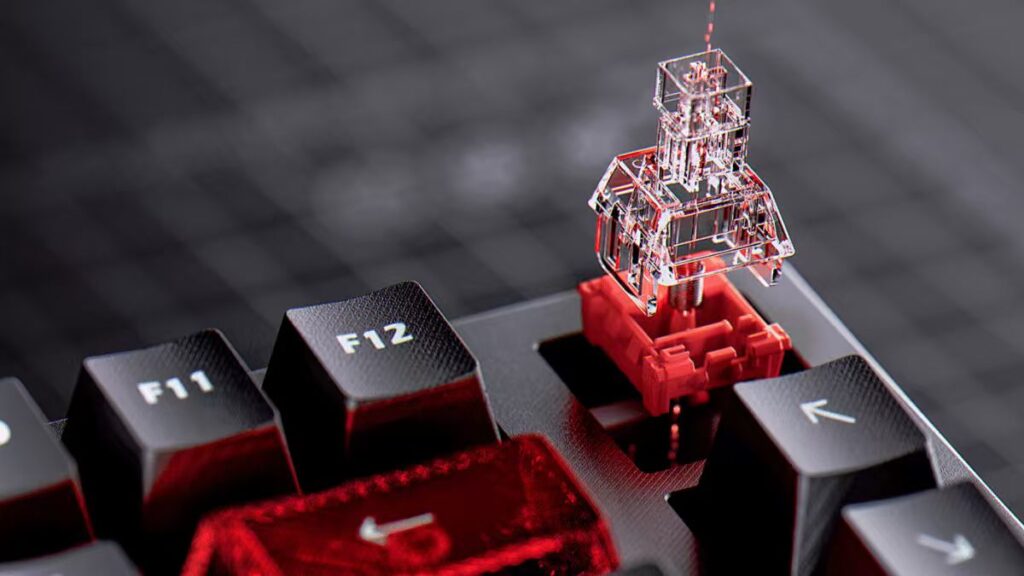
What Makes Mechanical Keyboard Applications Demanding for PFPE Grease?
Keyboard switches combine precise conditions:
– Micro-scale sliding. A switch stem travels ~4 mm per keystroke on housing rails. Contact area is measured in mm². The lubricant must provide consistent resistance without pooling or channeling.
– Millions of cycles. A keyboard may accumulate 50-100 million keystrokes. The lubricant must maintain performance without migrating, drying, or degrading.
– Mixed plastic interfaces. Housings and stems are POM, PBT, PC, or nylon. The grease must be fully compatible – no swelling, stress cracking, or dimensional change.
– Extremely small quantities. A single switch needs only milligrams. Over-application causes sluggish return or migration onto contacts.
– Zero tolerance for contact contamination. Grease on the metal leaf contacts can interfere with conductivity. The grease must stay on mechanical surfaces only.
– Uniformity across all keys. A 60-110 switch keyboard must feel consistent. Uneven distribution creates noticeable variation.
– Sensitivity to viscosity. Smoothness and sound are directly influenced by grease viscosity. Too thick → sluggish return; too thin → insufficient smoothing and rattle.
Why Do Keyboard Problems Persist Even When PFPE Grease Is Applied?
Six failure modes continue to cause issues:
1. Over-lubrication causing sluggish return. Too much grease or too thick a formulation prevents the spring from returning the stem quickly, causing missed or repeated keystrokes.
2. Grease migrating onto electrical contacts. Low-viscosity PFPE oil or over-application can flow onto leaf contacts during repeated actuation, causing intermittent contact or failure.
3. Inconsistent application between switches. Manual application without controlled quantities produces key-to-key feel variation – the most common complaint in hand-lubed keyboards.
4. Using the wrong viscosity for the switch type. Linear switches (smooth travel) benefit from different viscosity than tactile switches (bump mechanism). One-size-fits-all produces suboptimal results.
5. Grease displacement over millions of cycles. Some greases are gradually pushed from the contact zone on stem rails, leaving the switch dry and scratchy after extended use.
6. Incompatibility with switch plastic blends. While PFPE is broadly plastic-compatible, some switch formulations use blends or additives that may interact differently. Verification remains important.
What Properties Determine Whether a PFPE Grease Will Perform in Mechanical Keyboards?
Key properties:
– Base oil viscosity. Lower viscosity (20-100 cSt at 25 °C) produces lighter feel and faster return; higher viscosity (100-500+ cSt) provides more damping and quieter operation.
– Thickener and NLGI consistency. PTFE, silica, or fluorinated thickeners. NLGI 1-2 is typical – soft enough for thin films, structured enough to stay in place.
– Chemical inertness. PFPE’s C-F bonds provide exceptional stability. It does not react with switch plastics, metals, or contaminants – a fundamental advantage over hydrocarbon alternatives.
– Plastic compatibility. PFPE is compatible with POM, PBT, PC, nylon, and most engineering plastics. No swelling or stress cracking.
– Low migration tendency. Properly formulated PFPE stays on stem rails rather than flowing to contacts or pooling at the housing base.
– Long-term stability. PFPE does not oxidize, evaporate, or degrade. Low vapor pressure ensures effectiveness for the keyboard’s entire service life.
– Dielectric properties. PFPE is electrically insulating, so incidental contact with components will not cause short circuits – though contact with leaf switches should be avoided.
How to Select the Right PFPE Grease for Your Mechanical Keyboard
Step 1 – Identify the switch type:
| Switch Type | Characteristic | Lubrication Priority |
| Linear | Smooth, consistent travel | Smooth slide, reduced rattle, quiet |
| Tactile | Noticeable bump | Preserve bump while smoothing rails; avoid over-damping |
| Clicky | Audible click | Smooth rails without dampening click; light application |
| Stabilizer | Wire for large keys | Rattle elimination, smooth travel; higher viscosity OK |
Step 2 – Match viscosity: Linear switches benefit from 50-150 cSt base oil. Tactile switches need 20-80 cSt to preserve bump feel. Stabilizer wires can use 200-500+ cSt for rattle elimination.
Step 3 – Apply correctly: Milligram quantities per switch. Stem rails, spring ends, housing rails only. Avoid contact surfaces. Use controlled tools for consistency.
Quick Reference: Selection Guide
| Switch / Component | Key Properties | Direction |
| Linear switch | Smooth slide, quiet, consistent | PFPE 50-150 cSt; NLGI 1-2; PTFE or silica thickened |
| Tactile switch | Preserve bump, smooth rails | PFPE 20-80 cSt; lighter consistency; minimal application |
| Clicky switch | Smooth rails, preserve click | PFPE 20-50 cSt; thin film on rails only |
| Stabilizer wire | Rattle elimination, smooth travel | PFPE 200-500+ cSt; thicker; apply to wire contact points |
| Spring | Reduce ping, smooth compression | Very light PFPE oil or thin grease; minimal quantity |
| OEM production | Consistency, automated application | Controlled rheology PFPE; validated for dispensing equipment |
How VNOVO Provides Technical Support
VNOVO does not supply off-the-shelf “keyboard PFPE grease” with universal claims:
Application-Oriented Selection Guidance – VNOVO reviews your switch type, materials, desired feel, and production method (hand-lubed vs. automated), mapping them against PFPE formulation categories to recommend base oil viscosity, thickener type, NLGI consistency, and application quantity per switch.
Material Compatibility Verification – VNOVO helps assess candidates against all switch materials: housing polymer (POM, PBT, PC, nylon), stem polymer, spring steel, and coatings – with emphasis on plastic compatibility and contact safety.
Scenario-Based Communication Support – VNOVO provides rationales explaining *why* a direction is suggested, what trade-offs exist (higher viscosity = smoother and quieter but may slow return vs. lower viscosity = faster return but less damping; more grease = more consistent initially but higher migration risk over millions of cycles), and what validation steps to prioritize.
Conclusion
When to use PFPE grease in mechanical keyboards
When the application demands long-term stability without oxidation, requires verified compatibility with engineering plastics, needs chemical inertness to avoid any interaction with switch materials, or requires minimal migration risk over millions of cycles.
When PFPE may not be necessary
When the keyboard is low-cost where shorter service life is acceptable, production volume does not justify PFPE’s premium cost, or the application involves only stabilizer wires where synthetic hydrocarbon greases provide adequate performance.
What VNOVO can support
1. Selection guidance – translating switch type, materials, desired feel, and production method into PFPE viscosity range, thickener type, consistency, and application quantity
2. Material matching – assessing compatibility between PFPE candidates and all switch housing polymers, stem materials, spring steel, and coatings
3. Scenario communication – providing the technical rationale and decision framework to specify, validate, and apply the right PFPE grease for your mechanical keyboard application
*This article is provided for informational purposes based on publicly available industry references and established lubrication engineering principles. Specific product selection should always be verified against the switch manufacturer’s guidelines, OEM recommendations, lubricant supplier technical data sheets, and material compatibility data.*